Opinion and Insights
The Chandler Good Government Index (CGGI) was founded in the belief that good governance is built on capabilities. Six of the Index’s seven pillars measure the inputs and enablers of good governance, from Leadership & Foresight to Financial Stewardship and Global Influence & Reputation. These are concrete skills, systems, and processes that can be tracked, learned, and measurably improved. The seventh, Helping People Rise, asks whether those capabilities are making a difference. Are citizens healthier, safer, better educated, and more fairly treated?
The Helping People Rise pillar comprises ten indicators that cover Education, Health, Satisfaction with Public Services, Personal Safety, Environmental Performance, Income Distribution, Employment, Gender Equality, Price Stability, and Non‑Discrimination. In this year’s CGGI, it is the second‑most improved pillar, both year‑on‑year and over the full six‑year period since the Index was first published. Nearly 73% of countries improved their Helping People Rise scores between 2025 and 2026, and 63% of those tracked since 2021, recorded higher scores over the full period. The pillar’s global average score has, for the first time, edged far above its 2021 baseline.
This matters for two reasons. First, Helping People Rise is one of only two pillars driving the year‑on‑year CGGI recovery in 2026. Second, and more importantly, the pattern of Helping People Rise improvement across the Index raises a question at the heart of the CGGI. Does investing in government capabilities lead to better outcomes for people?

The Capabilities Connection
An analysis of CGGI data from 2021 to 2026 suggests that it does. Countries that entered the period with stronger capabilities were far more likely to see their Helping People Rise scores improve over the following five years.
Relationship Between Capabilities and Helping People Rise Score Changes (2021–2026)
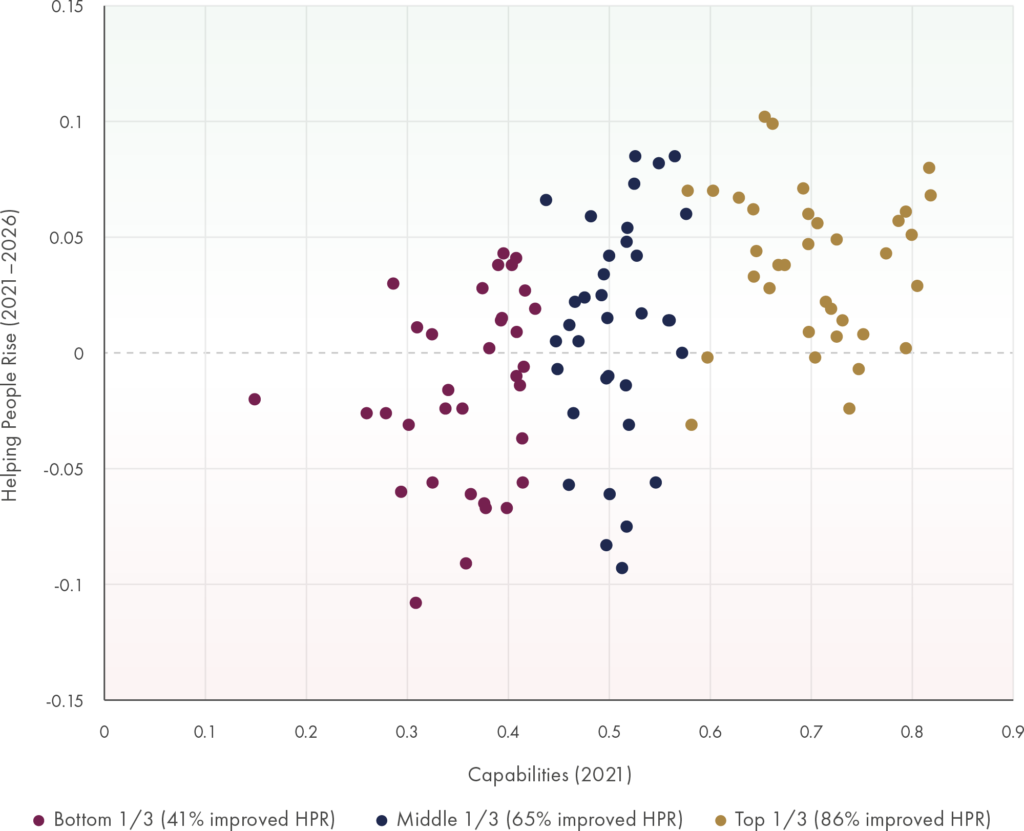
The strongest association is with Robust Laws & Policies, the pillar that captures the Rule of Law, Judicial Quality, Transparency, and Regulatory Governance. Among countries in the top third for Robust Laws & Policies scores in 2021, 91% saw their Helping People Rise scores grow by 2026, compared with 38% in the bottom third. Strong Institutions shows a comparable pattern, with 88% of the countries in the top third improving their Helping People Rise scores, compared with 41% in the bottom third.
The CGGI data does not establish a causal link between governance capabilities and Helping People Rise improvement. National wealth is also a predictor of better Helping People Rise scores, though a slightly weaker one. Still, the finding is relevant for policymakers. Countries that maintain strong legal frameworks and capable institutions are often those where citizens’ lives are improving most.
Countries with stronger capabilities in 2021 were far more likely to see their Helping People Rise scores improve over the following years.
Stronger Capabilities Drive Larger Gains
The UAE recorded the largest improvement in Helping People Rise among indexed countries. A federation of seven emirates with a resident population of roughly 10 million, of whom approximately 88% are non‑citizens, the UAE undertook one of the most ambitious governance reform programmes since the CGGI was launched. Federal Decree‑Law No. 33 of 2021 replaced the 1980 labour law in its entirety, mandating fixed‑term contracts, equal pay, and legal recognition of flexible work.
The government also launched NAFIS, an employment programme backed by AED 24 billion, approximately US$ 6.5 billion, which increased private‑sector Emirati employment from roughly 29,000 to over 157,000 by 2025. Mandatory health insurance was extended nationwide from January 2025, and personal status reforms expanded legal protections for the non‑citizen majority.
These are the kinds of governance investment that the CGGI’s capability pillars are designed to measure, and the UAE’s scores reflect it. Between 2021 and 2026, its Leadership & Foresight score rose from 0.644 to 0.828 and Strong Institutions from 0.570 to 0.751. Robust Laws & Policies was the one exception, with the UAE’s score barely moving over the period. The country’s Helping People Rise gains were associated with broad capability improvement rather than with strength in any single pillar.
Strong government capability scores did not guarantee Helping People Rise improvement in every case. Botswana entered the measurement period with rule‑of‑law scores stronger than several of the improving countries, yet recorded one of the largest Helping People Rise declines. Diamonds account for over 80% of the country’s exports, and when global prices collapsed, Botswana’s mineral revenue fell from a budgeted BWP 25.2 billion (approximately US$ 1.9 billion) to BWP 8.7 billion (approximately US$ 640m), while unemployment surged to 27.6%.
Botswana’s Robust Laws & Policies score improved from 0.562 to 0.611 over the period, indicating that formal legal and regulatory quality held. But its Financial Stewardship score fell sharply, from 0.534 to 0.465, and Leadership & Foresight declined from 0.588 to 0.551. Successive governments had not diversified the economy and could not sustain health financing as revenues fell. The case suggests that legal and regulatory quality, while important, is insufficient on its own. Citizen outcomes also depend on whether governments can manage public finances and adapt to changing conditions.

The two cases illustrate the same finding from opposite directions. Capability scores were associated with Helping People Rise improvement, but only when governments translated institutional strength into the needed reforms.
Implications for Policymakers
Citizen outcomes are improving across most of the world, and more broadly than at any point since the CGGI was launched. The breadth of the recovery across regions and income brackets is encouraging.
CGGI data suggests that investing in governance capabilities does translate into improved Helping People Rise scores, but it does not do so automatically. Even in a period of stretched finances and deep geopolitical uncertainty, governments across the income spectrum have found ways to improve the outcomes that Helping People Rise measures. Those with stronger governance foundations appear to have been better positioned to do so. The investments countries make in their laws, institutions, and administrative capacity today will shape whether their citizens are healthier, safer, better educated, and more fairly treated for years to come, provided governments act on them.
In a period of stretched finances and deep geopolitical uncertainty, governments have found ways to improve outcomes for citizens.