Opinion and Insights
Launched in 2021, the annual Chandler Good Government Index (CGGI) has consistently shown that governments with stronger capabilities are better equipped to face crises and deliver superior outcomes to citizens. Governments that painstakingly built capabilities were better prepared to fight the pandemic and remain equipped to navigate risks stemming from geopolitical conflicts, trade wars, a worsening climate crisis, and domestic factors.
The key message of the CGGI’s sixth edition is one of cautious optimism. Of the 120 countries indexed in 2025, 61% recorded higher overall scores in 2026, the biggest annual improvement to date. While this lifted the global average CGGI overall score to the highest level since 2022, only 43% of the 104 countries tracked continuously since 2021 improved their overall scores during the six‑year period.
Global Average
CGGI Overall Score (2021–2026)

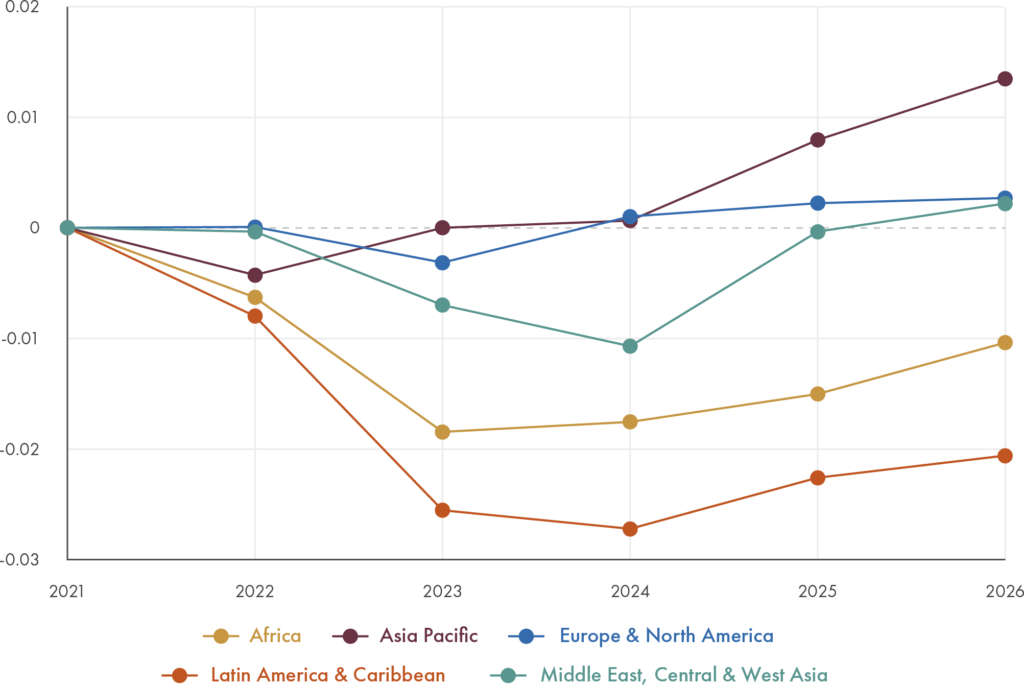
Average Regional CGGI Overall Scores
(Year‑on‑Year Change 2021–2026)
This indicates two things. First, that the improvement in the global average CGGI overall score is partly driven by the growth of the Index itself and the inclusion of 29 new countries since 2021. Second, that despite recent improvements in overall country scores, persistent governance challenges exist at a time when geopolitical conflicts and economic uncertainties have intensified.
While each country’s overall CGGI score determines its rank and indicates the winners of the governance competition, the direction and magnitude of score changes provide insights into whether governance quality is improving year‑to‑year, and its trajectory since 2021.
We unpack these changes from 2025 and examine the trend since 2021 to assess whether a rising tide is lifting all, or only some, of the boats.

The Winners
Singapore takes the top CGGI rank for the fourth straight year in 2026, Norway climbs two rungs to rank second, and Denmark retains third place on the podium. Notably, Iceland returns to the global top 20 after a three‑year hiatus, to rank 19th, displacing France, which drops to 22nd place.
Nineteen of the top 20 countries remain unchanged from 2025, with 14 from Europe, five from Asia Pacific, plus the United Arab Emirates (UAE), and Canada comprising the leading pack. In fact, this pattern has held steady over six years, with 16 countries consistently featuring in the top 20 and maintaining high ranks across various pillars.
These high‑performing governments have earned their laurels through leadership and foresight and decades of efforts to establish the rule of law, build strong institutions, pursue prudent financial management, attract investments, bolster their global influence and reputation, and improve the lives of their citizens. A deeper dive into CGGI data reveals unevenness in government effectiveness across regions, as well as measures of capabilities and outcomes.
Asia Pacific leads the rebound with 79% of countries improving in 2026, while Europe & North America and Latin America & Caribbean trail the pack with 49% and 47% improving, respectively.
An Uneven, Fragmented Recovery
In the aftermath of the pandemic, most countries saw their overall CGGI scores ebb for two years before reaching a turning point in 2023. The tide has since swelled for the third straight year, with 61% of countries improving in 2026 versus 60% in 2025, 49% in 2024, and a low of 31% in 2023.
The improvement is uneven across regions. Asia Pacific leads the rebound with 79% of countries improving year‑on‑year in 2026, followed by Africa—the most challenged and lowest‑scoring region among the five—with 71%, and Middle East, Central & West Asia with 69%. Europe & North America and Latin America & Caribbean trail the pack with 49% and 47% of countries improving, respectively. Europe & North America also accounted for 20 of the 47 countries across the world whose CGGI scores either declined or were unchanged in 2026.
The six‑year timeseries paints a contrasting picture. Less than half the countries tracked continuously since 2021 improved their overall scores. Average regional overall scores for three of the five regions increased over the period, with Asia Pacific and Europe & North America improving the most, followed by the Middle East, Central & West Asia. However, despite recent improvements, Africa and Latin America & Caribbean remain under water as their regional averages are still below 2021 levels.
A Rising Tide, Leaky Boats
An even more nuanced picture emerges when we analyse global average scores across the CGGI’s seven pillars—six of which measure government capabilities and one, Helping People Rise, gauges outcomes.
In 2026, the global average scores for three pillars improved year‑on‑year, while three others declined, and one was unchanged. The biggest increase was in Financial Stewardship, followed by relatively modest improvements in the Strong Institutions and Helping People Rise pillars.
The 2026 uptick in Financial Stewardship is notable for two reasons. First, it ends five years of steep declines amid worsening fiscal strain as the pandemic triggered higher spending, which was often financed with debt as state revenues shrank. Second, the spike comes from a very low base and Financial Stewardship remains the weakest CGGI pillar.
While the global average CGGI overall score has risen to a five‑year high, the improvement since 2021 is propped up by only two of the seven pillars.
Global averages for five pillars have declined since 2021, with Strong Institutions and Helping People Rise doing the heavy lifting to buoy the overall Index. The drop is the steepest for Financial Stewardship, while Strong Institutions remains the most improved pillar. This pattern is mirrored across most regions.
That suggests sustained improvement in the Strong Institutions pillar since 2021 is a key contributor to the rising tide underpinning gains in the Helping People Rise pillar and the Index as a whole.


An Uncertain Outlook
The improvement in overall CGGI scores in 2026 offers cautious encouragement, suggesting that the tide is on the rise after ebbing for several years in the aftermath of the pandemic, but five pillars remain under water compared to 2021. The six‑year trend shows fragility given the choppiness witnessed across pillars.
This imbalance comes at a time of heightened geopolitical and economic uncertainty, marked by intensifying strategic rivalries, rising trade fragmentation, and conflicts such as the recent war involving Iran, the U.S., and Israel that spread across the Middle East, and the effects of which reverberated globally.
In this environment, governments that restore fiscal resilience, demonstrate strategic leadership, and support open, competitive markets will be better positioned to navigate shocks and sustain progress. Without renewed focus on these pillars, the recent gains could prove short‑lived.
The tide is on the rise after ebbing for several years following the pandemic, but five pillars remain under water compared to 2021. The six‑year trend shows fragility given the choppiness witnessed across pillars.