
Country Stories
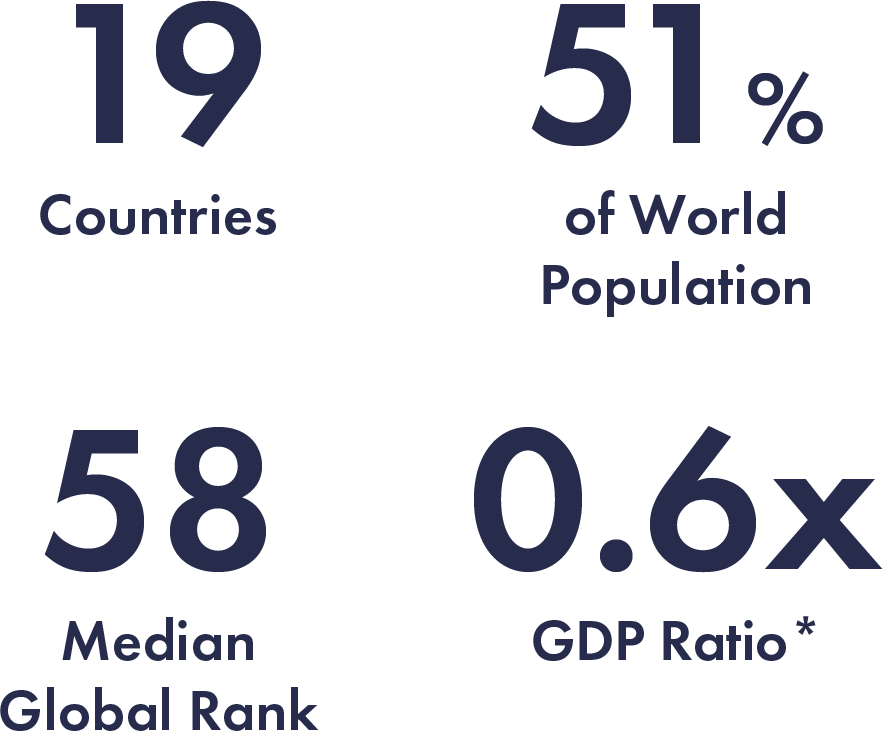
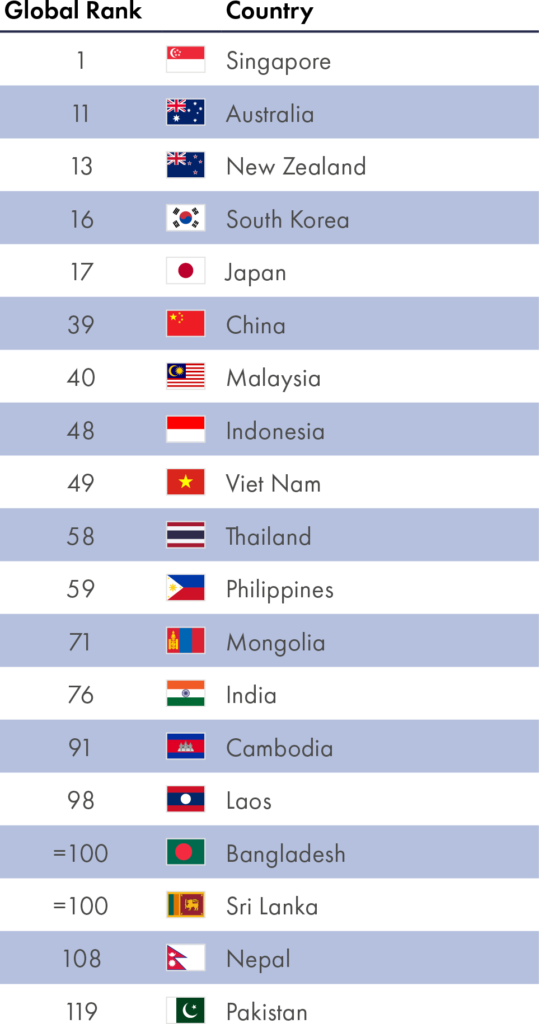
Asia Pacific is the world’s most populous region and home to just over half of the global population. The 19 Asia Pacific countries in the CGGI have a combined population of nearly 4.2 billion—with India and China alone accounting for about 68%—and an average per capita GDP of about US$ 18,084. Asia Pacific was the most improved region in 2026, with 79% of countries increasing their scores, and it remains the second‑best performer since 2021. The region accounted for five out of the top 20 ranked countries in 2026—with Singapore holding the No. 1 global rank for four consecutive years—and 11 countries ranked in the top half of the CGGI.
Asia Pacific
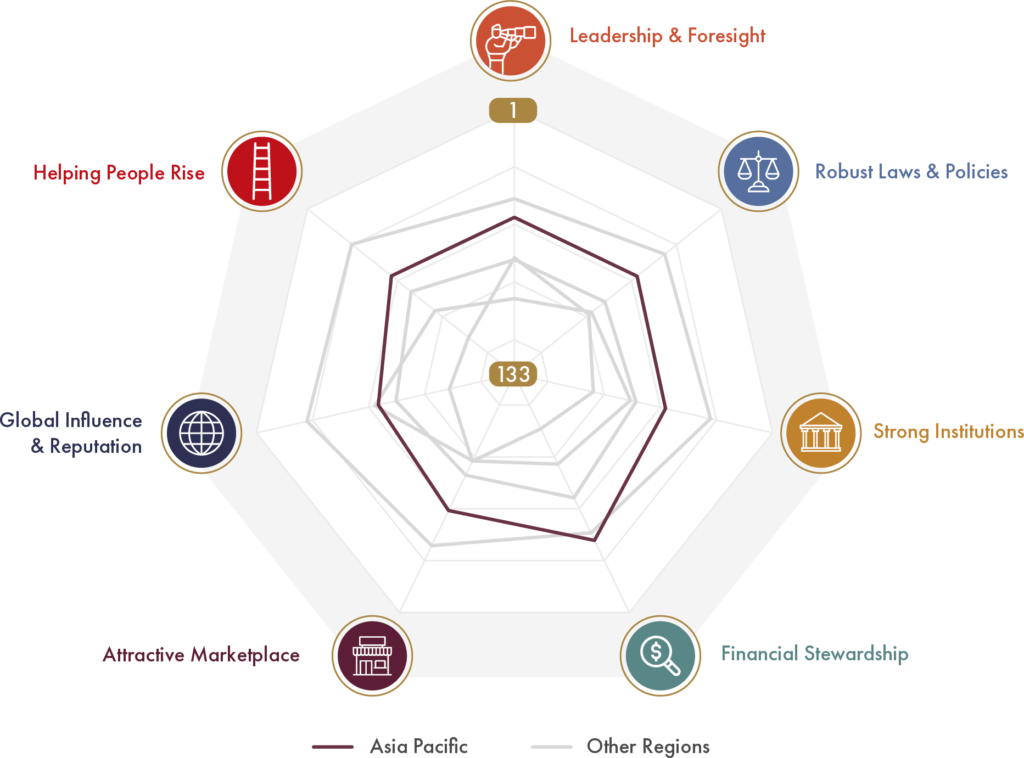
Average Pillar Ranks in 2026
Asia Pacific
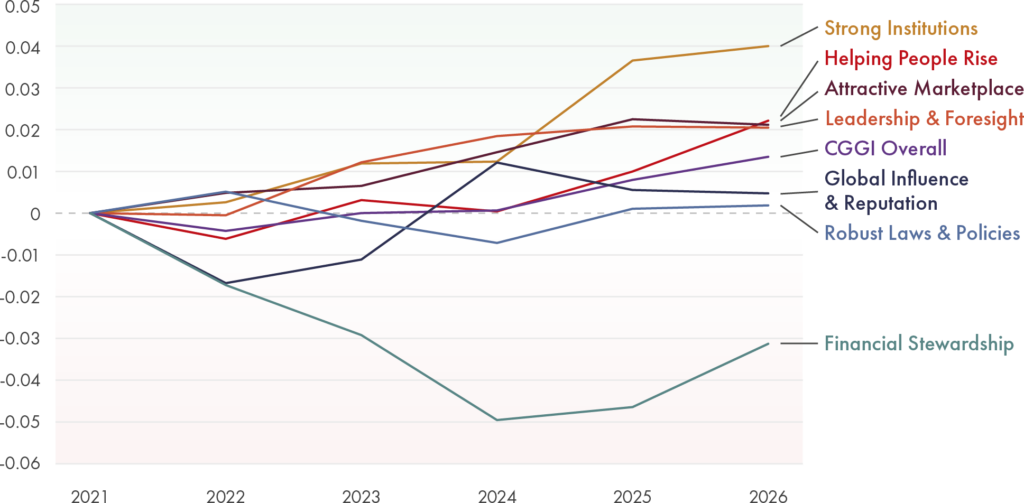
Average Pillar Scores (Year‑on‑Year Change 2021–2026)
The World’s Growth Engine
The 19 Asia Pacific countries covered in the Index account for roughly half the world’s population.1 No other region combines such demographic weight with economic momentum: Asia Pacific is forecast to contribute around 60% of global growth in 2025 and 2026.2
More than 2.2 billion people in Asia already live in cities—over half the world’s urban population—and that number is expected to rise by another 1.2 billion by 2050.3 At the same time, the region is undergoing the largest middle‑class expansion in history. By 2035, Asia Pacific is projected to be home to 3.2 billion middle‑class members.4 India and China alone are projected to add more than 570 million such consumers over that period, while Southeast Asian nations are projected to add 112 million new members. As one analysis concluded, this shift is poised to “reshape global consumption”.5
Demographic Divergence
Japan, South Korea, and Singapore face rapidly ageing and shrinking workforces. China is entering a similar demographic phase.6 By contrast, India, Pakistan, Bangladesh, Indonesia, and the Philippines still benefit from relatively young populations. That means two transitions are taking place within the region: managing ageing in some economies and building jobs and productivity fast enough in others to convert demographic potential into sustained growth.
By the early 2030s, several East Asian economies will have more retirees than new labour market entrants each year, while parts of South and Southeast Asia are still expanding their working‑age populations.7,8 That asymmetry will shape fiscal priorities, labour mobility, and regional integration, and may increasingly influence migration patterns within the region.
Growth Under Pressure
The risks of climate change are pronounced in Asia Pacific. Around 60% of the region’s population lives in areas highly exposed to climate hazards.9,10 Roughly three‑quarters of the region’s GDP depends on sectors tied closely to natural capital, from agriculture and fisheries to tourism.11
Trade and geopolitics add another layer of complexity. Higher U.S. tariffs and rising protectionism weigh on export‑led models, yet intra‑Asian trade and new agreements are deepening regional integration.12 The Regional Comprehensive Economic Partnership (RCEP), the largest free trade agreement in the world, covers 15 nations in Asia Pacific and came into effect in 2022. With so much uncertainty surrounding international trade, countries that can offer regulatory predictability, efficient border administration, and reliable implementation of trade commitments are well positioned to be rewarded.

Sustained Regional Improvement
Asia Pacific holds the second‑highest average overall CGGI score and is home to the top‑ranked country, Singapore. Since 2021, Asia Pacific has recorded the largest improvement in average overall CGGI score among the five regions.
Over that period, Asia Pacific is the only region to strengthen its average scores in six of the Index’s seven pillars. The region’s strongest gains were concentrated in two pillars: Helping People Rise and Strong Institutions. Many headlines understandably focus on the region’s growth and geopolitics, yet these suggest an equally important story receiving less attention: how governments are strengthening core systems and improving outcomes.
Even Asia Pacific’s lesser gains were world leading. Between 2021 and 2026, no other region recorded larger gains in average scores for the Attractive Marketplace or Leadership & Foresight pillars.
Notably, only three countries in the region—Mongolia, Viet Nam, and Japan—improved their scores in the Financial Stewardship pillar between 2021 and 2026, underscoring how challenging fiscal consolidation and spending discipline have become.
Four Different Subregions and Trajectories
Asia Pacific spans four distinct sub‑regions: East Asia (China, Japan, South Korea, Mongolia), South Asia (Bangladesh, India, Nepal, Pakistan, Sri Lanka), Southeast Asia (Cambodia, Indonesia, Laos, Malaysia, Philippines, Singapore, Thailand, Viet Nam), and Oceania (Australia, New Zealand).
All four East Asian countries improved their overall CGGI score between 2021 and 2026. Over that same period, China recorded the largest improvement in the Leadership & Foresight pillar of any country in Asia Pacific, while Mongolia made the strongest gains in the Attractive Marketplace pillar.
South Asia presents a more varied picture. It includes four of the five lowest‑scoring Asia Pacific nations, and only one South Asian country, Nepal, improved its overall score between 2021 and 2026. Yet within that challenging backdrop, India recorded the largest score improvement in South Asia in the Helping People Rise pillar since 2021.
Southeast Asia is home to both Singapore, the top‑ranked country in the CGGI, and Viet Nam, which recorded the largest overall score improvement in Asia Pacific since the Index began. Oceania, meanwhile, is the highest‑performing sub‑region, with both Australia and New Zealand ranking in the top 20 countries globally.

India
India’s CGGI performance between 2021 and 2026 is mixed. It improved in only one pillar, Helping People Rise, and its overall score declined. The steepest decline came in the Leadership & Foresight pillar. Between 2025 and 2026, however, the picture shifted: the country’s overall score improved, with gains in Financial Stewardship and Helping People Rise pillars. Over the past decade, India has significantly expanded large‑scale social programmes aimed at improving access to healthcare, education, and basic services, including initiatives such as Ayushman Bharat, which provides health insurance coverage for low‑income households, alongside wider investments in digital public infrastructure, and service delivery systems.13,14 More recently, fiscal policy has focused on stabilising public finances while sustaining capital investment and simplifying tax compliance for businesses and small enterprises.15,16

Japan
Japan improved its overall CGGI score between 2021 and 2026, with the largest gain coming in the Strong Institutions pillar, while its Leadership & Foresight score declined. Japan’s global top ten rank in Helping People Rise was supported by strong score improvements in indicators of Gender Gap and Non‑Discrimination, which coincide with legislative changes targeting women’s workforce participation. A 2025 update to the Act on the Promotion of Women’s Participation and Advancement in the Workplace extended gender pay gap reporting obligations for large businesses, introduced parental leave targets, and set board diversity requirements.17 On institutional efficiency, the Cabinet Secretariat has been piloting AI tools to manage and analyse publicly funded projects with an aim of embedding that capability across government by 2028—an initiative that could potentially be reflected in future scores for the Strong Institutions pillar.18,19

Singapore
Singapore has held the top CGGI rank for four consecutive years. The country strengthened its position in Financial Stewardship in 2026, registering its strongest year‑on‑year score improvement to regain the No. 1 global rank in this pillar, boosted by improvement in the Country Budget Surplus indicator. Singapore’s constitutionally anchored balanced budget framework continues to deliver results: the 2025 fiscal year ended with a surplus equivalent to 1.9% of GDP, more than double initial projections, driven by robust corporate income tax collections.

Indonesia
Indonesia’s overall score improved between 2021 and 2026, with the largest gains coming in the Strong Institutions and Leadership & Foresight pillars. Its scores in the Adaptability indicator of the latter pillar improved and ranked in the global top ten. The Indonesian government has introduced a series of administrative and regulatory reforms. The Electronic‑Based Government System and Visi Indonesia Digital 2045 initiatives seek to advance the digitisation of public services and standardisation of government records.20,21

Australia
Australia’s overall score improved between 2021 and 2026, with gains in three of the seven pillars: Leadership & Foresight, Global Influence & Reputation, and Financial Stewardship. These shifts coincided with a period of deliberate long‑range policy commitment. The Future Made in Australia Act,22,23 passed in 2024, commits AUD 22 billion over a decade to transition to net‑zero emissions and boost manufacturing, establishing a National Interest Framework for renewables, critical minerals, and clean technology. Its 2025 Foreign Policy White Paper24 sets out a decade‑long strategy for economic security, regional alliances, and Pacific partnerships.
Endnotes