
Country Stories
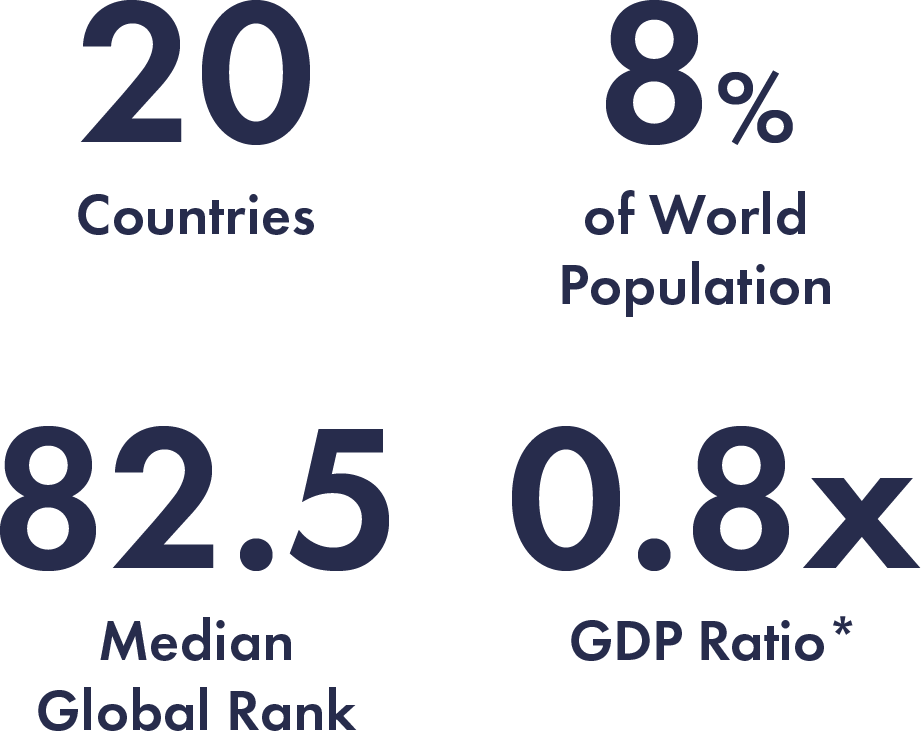
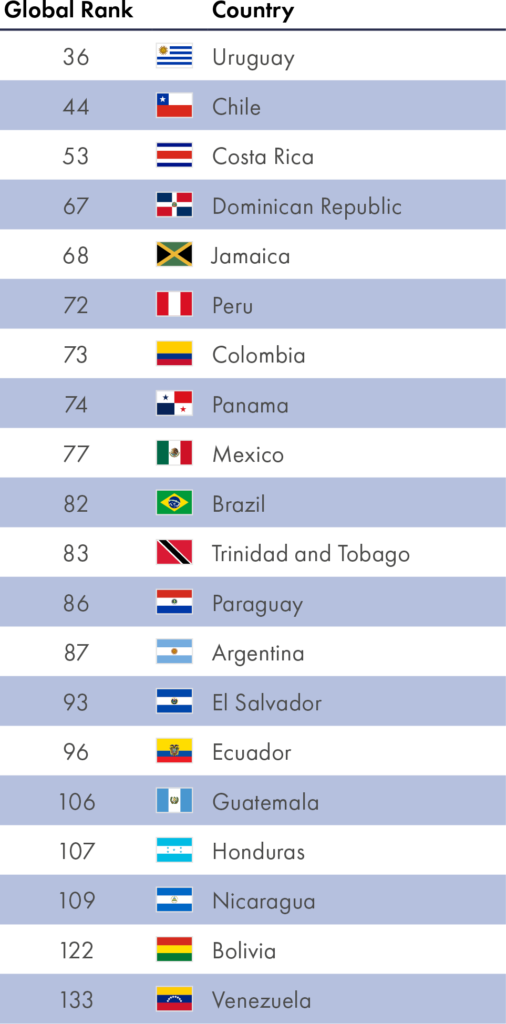
The Latin America & Caribbean region has 20 countries in the CGGI that are home to some 632 million people, or nearly 8% of the global population, with an average per capita GDP of about US$ 10,524. About 47% of the countries in the region improved their overall CGGI scores in 2026 from the previous year, and Latin America & Caribbean remains the second‑lowest performer in the Index since its launch in 2021. This reflects persistent governance challenges. Only two countries, Uruguay and Chile, rank within the global top 50. This year, one regional country was added to the Index, Trinidad & Tobago, which debuts with a CGGI rank of 83.
Latin America & Caribbean
Average Pillar Ranks in 2026

Latin America & Caribbean
Average Pillar Scores (Year‑on‑Year Change 2021–2026)

A Region at a Crossroads
The Latin America & Caribbean region sits at the centre of many of today’s defining global pressures: climate risk and deforestation in the Amazon basin, organised violence and migration flows through Central America and Mexico, and the reconfiguration of global supply chains towards nearshoring and “friendshoring”. The 20 countries covered in the Index represent one of the most urbanised regions in the world, with more than four in five people living in cities1—concentrating demand for public services in ways that magnify both efficiency gains and governance setbacks.
Over the past two years the region also experienced a historic demographic shift: for the first time, older adults required more care than young children.2 Across the region, falling fertility rates and rising life expectancy are reshaping fiscal and administrative agendas, bringing pensions, long‑term care, and productivity to the forefront while public finances remain strained.
Other pressures have compounded these constraints. Guatemala, Honduras, Nicaragua, El Salvador, and Mexico lie along the Western Hemisphere’s principal migration corridor, with millions moving through or departing each year.3
In 2025, one global monitoring service placed three Latin American countries among the top ten nations most affected by violent conflict and ranked Mexico as the world’s most dangerous non‑warring country4, with violence levels comparable to some recognised armed conflicts. Governments across the region are therefore simultaneously managing public safety, migration, and economic reform.
Public trust also remains fragile in much of the region. Surveys across Latin America consistently show lower confidence in national governments than OECD averages,5 reflecting public frustration with insecurity, inequality, and uneven service delivery.


For decades, the region’s story has been framed as one of untapped potential. Latin America & Caribbean holds a significant share of global reserves in critical minerals such as lithium and copper,6 plays a central role in exporting such staples as coffee and beef, and houses nearly 20% of the world’s known oil reserves.7 Yet, the region’s growth has consistently lagged behind global averages,8 as many countries have struggled to convert those advantages into durable economic gains.
Governance will be a decisive factor in whether this moment becomes another cycle of promise and disappointment, or the region rises to meet these opportunities.
A Mixed Governance Picture
Latin America & Caribbean remains the region with the second‑lowest average overall CGGI score and posts the lowest average scores in three pillars: Leadership & Foresight, Robust Laws & Policies, and Attractive Marketplace. Only two countries, Uruguay and Chile, rank within the global top 50 in 2026.
Since 2021, the region’s average overall CGGI score has declined. Over that same period, the region’s average scores fell in six pillars—Leadership & Foresight, Robust Laws & Policies, Financial Stewardship, Attractive Marketplace, Global Influence & Reputation, and Helping People Rise—highlighting the primary governance challenges that the region continues to face.
Yet the near‑term picture was more encouraging. Between 2025 and 2026, the region’s average overall CGGI score improved. Gains stood out for two pillars: Financial Stewardship and Helping People Rise, suggesting that some governments have stabilised fiscal management and strengthened delivery in areas tied to social outcomes. While the improvement does not erase the decline since 2021, it does indicate that capability can recover, even in a difficult environment.
Regional averages, however, conceal significant variations. Uruguay and Chile, the two highest‑ranked countries in the region, have performed well in areas where many of their regional partners struggled. Uruguay, for example, improved its overall score between 2021 and 2026, as it did across six of seven pillars. Chile, meanwhile, scored highly in several Leadership & Foresight‑related indicators.
The story is familiar to most regions: shared pressures have produced markedly different institutional outcomes.
Implementation, Not Reform, Is the Main Governance Challenge
Sandra Naranjo Bautista, Lead Specialist in Public Sector Management in the Institutions for Development Department at the Inter‑American Development Bank (IDB) and former Acting Vice President, Minister of Planning and Development, and Minister of Tourism in Ecuador, on what distinguishes Latin American governments that have strengthened implementation capacity in recent years.

SANDRA NARANJO BAUTISTA
Lead Specialist in Public Sector Management in the Institutions for Development Department at the Inter‑American Development Bank (IDB)
From our work across Latin America & Caribbean, reflected in our recently approved Thematic Framework Document on Institutional Capacity and Rule of Law, what most clearly distinguishes governments that have strengthened implementation capacity is not the formal adoption of reforms, but whether core public sector systems function coherently to translate those reforms into practice.
Implementation challenges in the region are not primarily about policy design. Rather, they stem from persistent institutional bottlenecks: rigid resource allocation, fragmented resource management systems, weak regulatory governance, and limited oversight and enforcement capacity. These structural constraints determine whether decisions are sustained beyond announcement and translated into measurable results.
There is wide variation across countries and sectors. Treating Latin America & Caribbean as an average hides large differences in fiscal credibility, civil service professionalism, procurement performance, and regulatory quality. Countries that appear more effective in implementation tend to exhibit fewer systemic disconnects across these core functions. Where fragmentation is widespread, reforms struggle to gain traction.
In public finance, we see two simultaneous realities. On the one hand, many countries have strengthened macro‑fiscal frameworks by adopting fiscal rules, medium‑term expenditure frameworks, and fiscal councils. Global evidence suggests that multiyear budgeting can improve fiscal balances, and countries such as Chile and Peru have embedded investment programmes within medium‑term frameworks. On the other hand, institutional fragmentation persists. In roughly 60%–70% of countries in the region, planning and budgeting remain institutionally separated, weakening coordination and accountability. Monitoring and evaluation systems are frequently disconnected from budget decision‑making, and line‑item budgeting continues to dominate, reinforcing incremental rather than strategic allocation.
It is not that integration automatically produces better outcomes. Instead, we have seen fragmentation as a recurring implementation constraint. Where planning, budgeting, and performance systems operate independently, strategic priorities and resource allocation are often weakly aligned. Similarly, in regulatory governance, uneven rule‑making practices, overlapping mandates across oversight bodies, and weak enforcement reduce predictability and undermine policy credibility.
From our research and experience, fragmentation largely stems from the siloed organisational structures that continue to characterise much of Latin America & Caribbean’s public sector. The absence of a whole‑of‑government approach limits the identification of synergies and hinders integration both across and within core cross‑cutting management systems.
Finally, successful reforms in the region tend to balance three mutually reinforcing dimensions: technical soundness, administrative feasibility, and political support. Technically robust reforms without political backing stall; politically driven reforms without administrative capacity falter. Implementation capacity improves when sound design, real capacity, and political backing move in the same direction.


Costa Rica
Costa Rica ranks third in the Latin America & Caribbean region and improved its overall CGGI score between 2021 and 2026, gaining ground in five of seven pillars. These results coincide with the country’s National Development and Public Investment Plan 2023–2026, which prioritises investment across a few cross‑cutting priorities: economic reactivation, state modernisation, inequality reduction, and citizen security.9,10 Costa Rica also boasts long‑standing investment in a universal primary care system, which, as coverage has matured, has lowered preventable mortality and avoidable premature deaths.11
Peru
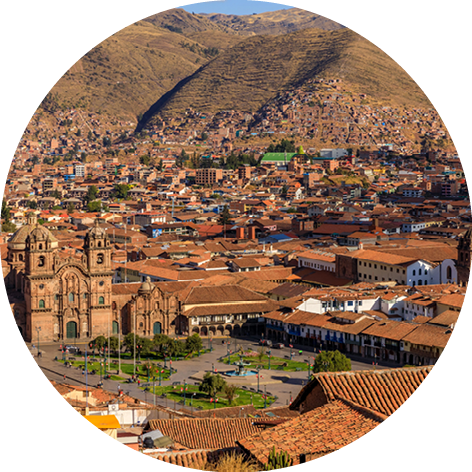
Peru’s long‑term trajectory has been difficult: its overall score declined since 2021, as did scores across all pillars. Yet its short‑term performance is better. Between 2025 and 2026, Peru improved its scores in the Financial Stewardship and Strong Institutions pillars. Peru met its budget deficit target in 2025 for the first time in three years, supported by stronger‑than‑expected revenue collection.12,13 Meanwhile, a Public Procurement Law introduced in April 2025 adds value‑for‑money criteria and sustainability standards to government purchasing,14 while a National Digital Transformation Plan linked over 100 government systems through a State Interoperability Platform, enabling data‑sharing across ministries.15,16
Brazil
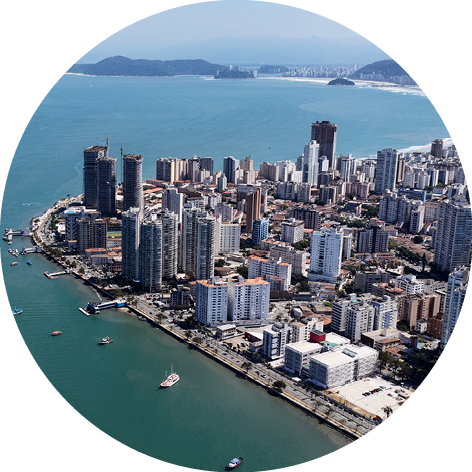
Latin America’s most populous country, home to roughly 213 million people,17 Brazil has seen its overall CGGI score decline since 2021, registering lower scores in four pillars. The Strong Institutions and Global Influence & Reputation pillars saw the sharpest declines since 2021, while Financial Stewardship recorded the largest increase. The country published a 2023 Fiscal Framework replacing an earlier spending cap with rules tying expenditure growth to revenue, with primary surplus targets progressing from negative to positive across a four‑year horizon.18

Chile
Chile is the second‑highest ranked country in the region, though its trajectory has been challenging. Its overall score declined between 2021 and 2026, as did scores in five of seven pillars. The exception was Helping People Rise, which improved. Year‑on‑year, its strongest gains came in Financial Stewardship. A major pension reform enacted over this period established a new public social security fund, raised the universal basic pension, and gradually increased mandatory employer contributions, with explicit mechanisms to narrow the gender pension gap.19 Minimum wage increases ran alongside those changes.20,21 On fiscal management, the IMF noted that Chile’s fiscal rules remain in place, with spending restraint and a new tax compliance law targeting public debt below 45% of GDP through 2030.22

Uruguay
Uruguay is the best‑performing country in the region. Since 2021, it has gained ground in six of seven pillars, with the highest score improvements in Leadership & Foresight, followed by Helping People Rise. Uruguay’s 2025–2029 Multi‑Annual Budget Law sets a five‑year fiscal roadmap anchored by a dual fiscal rule, new tax measures, and revenue modernisation, targeting structural primary balance by 2029.23 Uruguay has also developed a National Security Plan designed to address drug trafficking and violence.
Endnotes