Country Stories
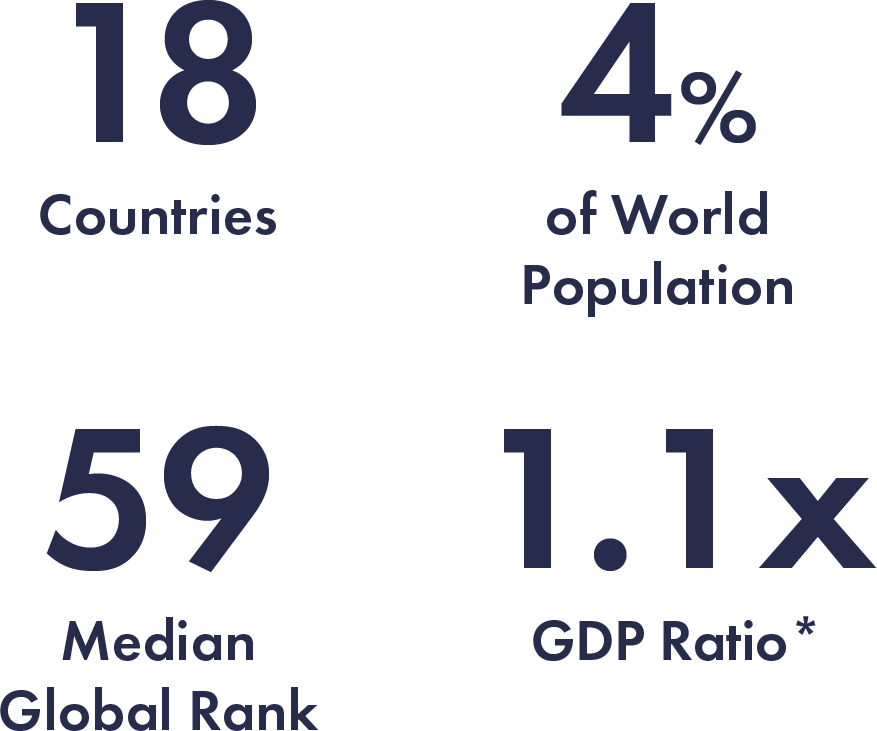
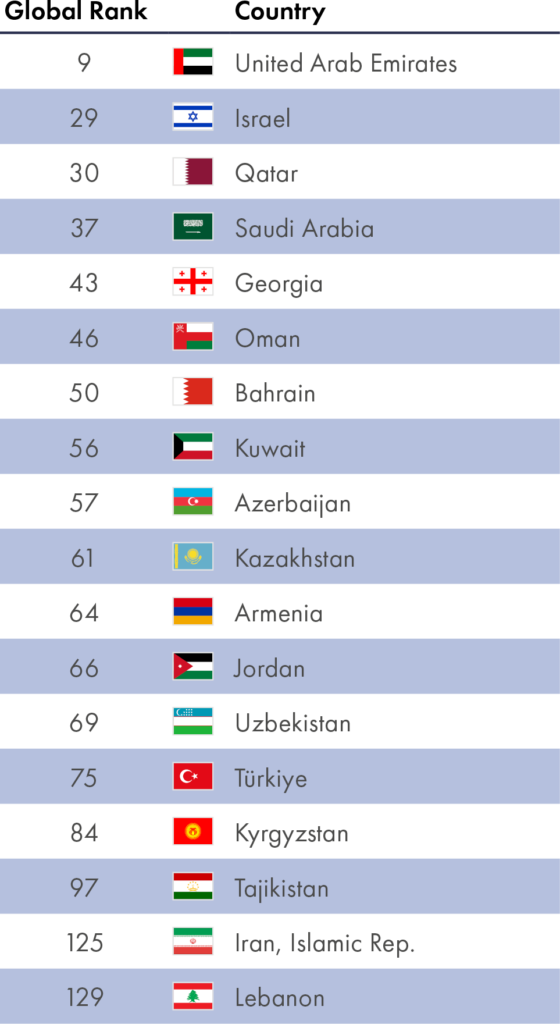
The 18 countries from the Middle East, Central & West Asia included in the CGGI have a total population of about 357 million and an average GDP per capita of US$ 20,791. These include five countries added to the Index in 2026: Bahrain, Oman, and Qatar from the Middle East, and Azerbaijan and Uzbekistan from Central Asia. While all but four countries improved their overall CGGI scores in 2026, wide variance in rank and score performances are prevalent in the region. The United Arab Emirates is the region’s only representative in the global top 10 ranks and its overall CGGI score has improved more than that of any other country since the Index was launched in 2021.
Middle East, Central & West Asia
Average Pillar Ranks in 2026

Middle East, Central & West Asia
Average Pillar Scores (Year‑on‑Year Change 2021–2026)

Growth Amid Fractures
Countries in the Middle East, Central & West Asia region include hydrocarbon exporters with substantial fiscal buffers, middle‑income reformers navigating political strain, and smaller republics whose economic stability is influenced by remittances and geopolitical developments beyond their own borders. What they share is a position at the intersection of energy markets, trade corridors, and geopolitical fault lines—as amplified by the 2026 military conflict involving Iran, Israel, and the U.S.
Countries in the Middle East and Central Asia experienced strong economic growth in 2025 even though the region saw active armed conflict, renewed geopolitical tensions, and persistent uncertainty in global commodity markets.1,2 Growth was supported by oil revenues, recovering tourism, and reform momentum in several economies. CGGI data predates the 2026 conflict in Iran, therefore does not capture its effects across the region.
Oil exporters—including Saudi Arabia, the UAE, Kuwait and Kazakhstan—have benefitted from higher energy prices and rebuilt fiscal buffers, while pursuing long‑term diversification through ambitious national vision strategies, sovereign wealth funds, and fiscal reform programmes. For several governments in the region, structural reform has proceeded from a position of strength.
Elsewhere, the room to manoeuvre is narrower. Lebanon continues to experience severe economic fragility following its debt default, banking collapse, and the aftermath of the Beirut port explosion. Jordan faces fiscal constraints alongside persistent regional instability. A central governance challenge in such environments is how to restore core state functions amid diminished capacity.
Conflict, Migration, and Climate Stress
Research suggests the economic costs of conflict in this region are persistent. Analysis from the International Monetary Fund (IMF) of post‑conflict recovery episodes across the Middle East and Central Asia finds that only about one in three economies returns to pre‑conflict growth trajectories within five years, a lower success rate than in other parts of the world.3

Armenia, Georgia, and the Central Asian states remain exposed to effects from the Russia–Ukraine war. For countries such as Israel, Jordan, and Lebanon, recurrent security tensions carry fiscal and social implications that extend well beyond immediate defence spending. Institutional repair in this environment can be a decades‑long undertaking.
Migration and remittances are another structural layer. In Tajikistan, remittances reached 49% of GDP in 2024,4 the highest ratio of any country in the world. In Kyrgyzstan, the figure was around a quarter of GDP.5 More than 80% of migrants from both countries work in Russia,6 meaning that exchange‑rate movements, sanctions, and shifts in Russian labour demand transmit directly into household incomes and public finances.
Climate and water stress present two additional challenges. Much of the region is exposed to drought, extreme heat, and water scarcity. In the Gulf, desalination and energy‑intensive cooling underpin urban life, requiring sophisticated long‑term planning and regulation. In Jordan and Lebanon, water shortages intersect with refugee pressures and ageing infrastructure, turning environmental stress into a direct governance challenge. The IMF and World Bank now routinely place climate and water shocks alongside conflict and debt as central threats to long‑term stability in the region.7,8
Shared Pressures, Different Responses
Against that backdrop, CGGI data is more encouraging than headlines might suggest. Between 2021 and 2026, the region’s average overall CGGI score improved, notching the third‑largest gain among the five regions in the Index.
Middle East, Central & West Asia also registered the biggest improvement among regions in the Global Influence & Reputation and Strong Institutions pillars. While conflict and commodity prices draw attention, institutional systems in several countries have quietly strengthened.
The picture is not uniformly positive across pillars. Between 2021 and 2026, the region’s average score in the Attractive Marketplace pillar registered the steepest decline globally. This reflects the difficulty of sustaining investor confidence in an environment marked by volatility.
The UAE recorded the largest overall CGGI score improvement globally between 2021 and 2026 and posted the strongest gains in the region in five of the seven pillars, barring Robust Laws & Policies and Financial Stewardship. Georgia also improved its overall score over the same period and was one of only two countries in the region to register gains in the Robust Laws & Policies pillar. Kyrgyzstan, meanwhile, recorded the largest improvement in Financial Stewardship between 2021 and 2026, a result that is striking precisely because it came under structural constraints from its remittance dependence.
What emerges is a region defined less by common challenges than by the ways governments are responding to them. Some states are leveraging fiscal buffers to modernise administrative systems and extend their global influence. Others are strengthening legal frameworks and improving data systems despite constrained resources. A few remain in cycles of fragility where institutional repair is continuous and uneven. In several cases, institutional capability has strengthened even as marketplace conditions deteriorated. The data reveals how shared pressures—geopolitical uncertainty, climate stress, demographic shifts, and external economic shocks—are being met with markedly different responses.
Merit‑Based Bureaucracy is a Long‑Term Investment, Not a Quick Fix
Kazakhstan improved its overall CGGI score for the second consecutive year in 2026. Since 2021, the country has recorded sustained gains in indicators linked to Strong Institutions and Financial Stewardship pillars. Dr Alikhan Baimenov, Chairman of the Astana Civil Service Hub, reflects on the reforms that have strengthened Kazakhstan’s public administration while maintaining fiscal discipline.

DR ALIKHAN BAIMENOV
Chairman of the Astana Civil Service Hub
The steady performance in the CGGI reflects a consistent commitment to institutional reforms, although the process has not always been linear.
Since the late 1990s, a professional, merit‑based bureaucracy has been an integral part of state modernisation. This journey began with pioneering reforms in the region, including the introduction of meritocratic principles and the separation of political and career civil servants. In 1999, Kazakhstan became the first country in the Commonwealth of Independent States (CIS) region to introduce mandatory competitive selection in the civil service. Creating legal protections for career officials during political shifts, establishing the dedicated Agency for Civil Service Affairs, and introducing the Senior Civil Service system—together, these measures were factors that positively influenced the quality of the bureaucracy.
These efforts were reinforced by digitalisation initiatives, functional analysis of business processes, and the modernisation of national statistics. Further development was outlined in the 2021 Concept of Public Administration Development. In 2022, the Decree “On Measures to Debureaucratize the Activities of the State Apparatus” was adopted, which gave impetus to another stage of functional analysis.
As for Financial Stewardship, it is worth noting the sustained attention devoted to improving the budget process, planning, and fiscal policy. A clear example is the adoption last year of the new Budget Code and Tax Code.
It is also important to note that issues of public debt and the efficient use of budget funds remain in focus for both the public and Parliament. These efforts have been further supported by the People’s Participation Budget, which contributes to greater financial transparency. This also reflects the principles of the Listening State Concept.

How Demand‑Driven Training is Reshaping Armenia’s Public Service
Armenia has maintained its overall CGGI score improvement since 2024, with steady gains seen since 2021 in areas linked to institutional capability. Gayane Hovhannisyan, Head of the Department of Supplementary Education at the Public Administration Academy of the Republic of Armenia (PAARA), explains the changes that have helped strengthen institutional capacity.

GAYANE HOVHANNISYAN
Head of the Department of Supplementary Education at the Public Administration Academy of the Republic of Armenia (PAARA)
In recent years, efforts to strengthen institutional capacity in Armenia’s public administration have been driven not only by structural and regulatory reforms, but also by the growing role of professional development and continuous learning within the public service. Sustainable improvements in governance increasingly depend on how public servants learn, adapt, and apply new approaches
in practice.
An important step was the inclusion of the measure on “Improvement of the Non‑Financial Incentive System in the Public Sector” in the government’s 2021–2026 Action Plan. Amendments to the Law on Civil Service subsequently revised the regulation of training, making it more systematic, demand‑driven, and aligned with international and private sector practices.
Within the Public Administration Reform Strategy, improving the effectiveness of the training system has become a strategic priority for strengthening the competitiveness of the public service. The introduction of Training Needs Assessments has ensured that programmes respond to real managerial challenges and identified competency gaps.
PAARA has played an important role in this process, introducing more than two dozen new educational programmes in 2026 alone and expanding training resources since 2021. Such changes reflect a broader shift towards developing human capital as a foundation for sustainable governance reform.


Türkiye
Türkiye’s overall CGGI score fell between 2021 and 2026, with declines in five of the seven pillars. The steepest fall was in the Helping People Rise pillar, particularly the Price Stability indicator. The Global Influence & Reputation pillar improved, aided by gains in the Nation Brand indicator. Türkiye’s rebranding from “Turkey” was accompanied by a coordinated nation‑brand strategy managed through a dedicated Türkiye Brand Office.9,10

Georgia
Georgia improved its overall CGGI score between 2021 and 2026, with the largest gains in the Attractive Marketplace and Helping People Rise pillars and was one of two countries in the region to improve in the Robust Laws & Policies pillar. Such improvements coincide with a period of active business‑environment reform. The 2021–2026 Government Programme prioritised investment climate improvements, insolvency law updates, and public service modernisation, and the country submitted a 2025–2027 Economic Reform Programme to the European Commission covering macroeconomic stability and green economy commitments.11,12,13

Armenia
Armenia’s overall CGGI score fell between 2021 and 2026, with declines in five pillars offsetting gains in the Helping People Rise and Strong Institutions pillars. Improvements in institutional capability have coincided with public administration reforms emphasising training and professional development across the civil service, including new systems to identify skills gaps and expand public sector training programmes. Between 2025 and 2026, Armenia maintained or improved scores in five of the seven pillars, with its largest gain coming in Financial Stewardship. That improvement comes against the backdrop of the 2025 introduction of a Government Financial Management Information System, which unified accounting, human resources, and treasury functions across ministries.
Qatar
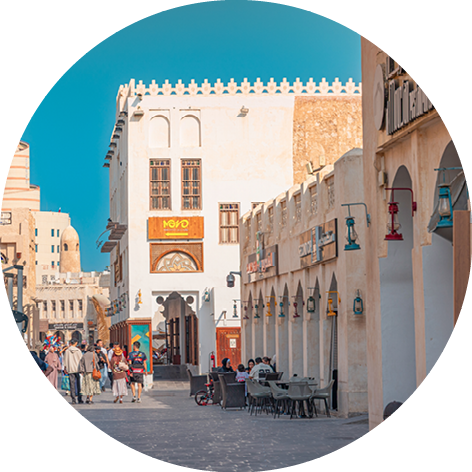
Qatar debuts in the CGGI this year and ranks in the global top ten countries in the Leadership & Foresight and Financial Stewardship pillars. Since launching its National Vision in 2008, Qatar has operated through successive National Development Strategies. The current strategy, covering 2024 to 2030, sets seven national outcomes including economic diversification, fiscal sustainability, workforce development, social cohesion, and government excellence, with granular targets attached to each.14,15,16

United Arab Emirates
The UAE is the region’s top‑ranked country and has improved its overall CGGI score every year since 2021, with gains in six of the seven pillars. Several blueprints—including We the UAE 2031, the National Strategy for Advanced Innovation, and the Future Foresight Strategy—formalise long‑range thinking as an operational function of the state.17 Between 2021 and 2026, the UAE recorded the biggest score improvement globally in the Helping People Rise pillar, lifted by gains in the Personal Safety and Gender Gap indicators. This coincided with federal gender‑balance policies, as well as establishing the Federal Gender Balance Council, which have helped increase women’s participation across sectors and representation in leadership roles.18
Endnotes